Diagnose Operational Physics
Map the value stream, failure patterns, queue behavior, and pressure signals to find where instability originates.
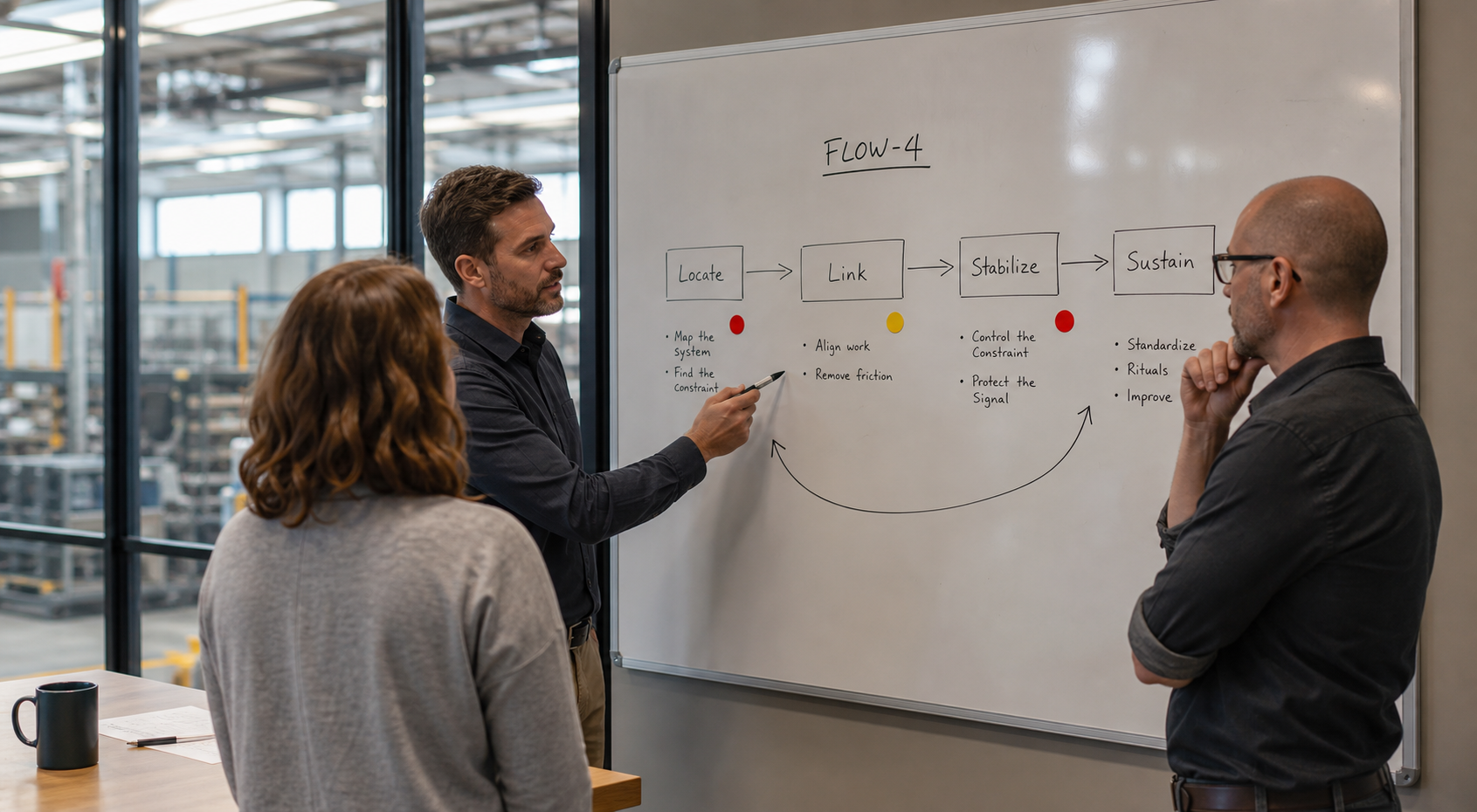
Method
FLOW-4 is LeanStorming's operating method for diagnosing pressure, stabilizing the control point, focusing improvement effort, and sustaining the execution loop.
Method language comes after the operating pressure is clear.
Book an Operating Pressure ReviewFLOW-4 Standard
The buyer may arrive through pressure, a solution page, or a Pressure Map. The improvement work still follows FLOW-4.
Map the value stream, failure patterns, queue behavior, and pressure signals to find where instability originates.
Protect flow with the operating controls, handoff rules, cadence, staffing moves, and escalation logic the system needs now.
Prioritize the few constraint-removal actions that change system performance instead of spreading effort across noise.
Install governance, owners, review rhythms, and learning loops so the operating logic holds as pressure changes.
FLOW-4
Every step connects back to buyer symptoms: backlog, WIP growth, release delay, handoff friction, labor imbalance, planning instability, and recovery lag.
Operational stabilization loop for diagnosing physics, protecting flow, and sustaining control.
Selected step
Observe
Value stream latency, queue propagation, and failure-pattern emergence
Decide
Where does instability originate, and which interactions are amplifying pressure?
Output
Diagnosed operational physics map and failure-point hypothesis
Buyer symptoms
Start with the operating environment, then use FLOW-4 to structure the work.
Execution Outcome
FLOW-4 turns diagnosis into control, then into sustained performance through operating governance.
Leaders gain a common operating language for instability, constraint behavior, and intervention sequencing.
Teams stop burning time on generic improvement activity and recover faster after disruption.
Improvement effort is concentrated on the few actions that materially change system behavior.
The method becomes an operating rhythm that holds under seasonal spikes, turnover, and demand variability.
Start with the 30-minute review to determine whether the next move is direct action, a Pressure Map, Stress Labs, fractional execution, or no additional spend.